
.png)
Authenticity is the operative word in DxO FilmPack's approach to film emulation, and it distinguishes the application from competitors that apply simple color grading and noise overlays to approximate a film look. DxO's methodology begins with physical specimens of the actual film materials, analyzing their grain structure under laboratory conditions and measuring their characteristic response curves across the full tonal and spectral range. The resulting mathematical models capture not just the average appearance of each film stock but the subtle variations and interdependencies between exposure level, grain behavior, and color saturation that give each emulsion its distinctive photographic personality. This scientific foundation means that FilmPack emulations respond to image content in the same nuanced ways as the original films rather than applying uniform transformations.
The creative toolkit within DxO FilmPack extends well beyond the film stock library itself. The color rendering engine provides access to tone curves, hue/saturation/luminance adjustments, and creative toning options that allow the base film character to be refined and customized for specific creative requirements. The monochrome workflow is particularly sophisticated, offering not just black-and-white film emulations but also colored filter simulations that replicate the effect of placing physical contrast filters over the lens — transforming the relationship between subject colors and tonal values in ways that parallel darkroom techniques. The split toning system enables subtle color casts to be introduced into highlights and shadows independently, adding warmth, coolness, or specific tonal biases that enhance the period character of the final image.
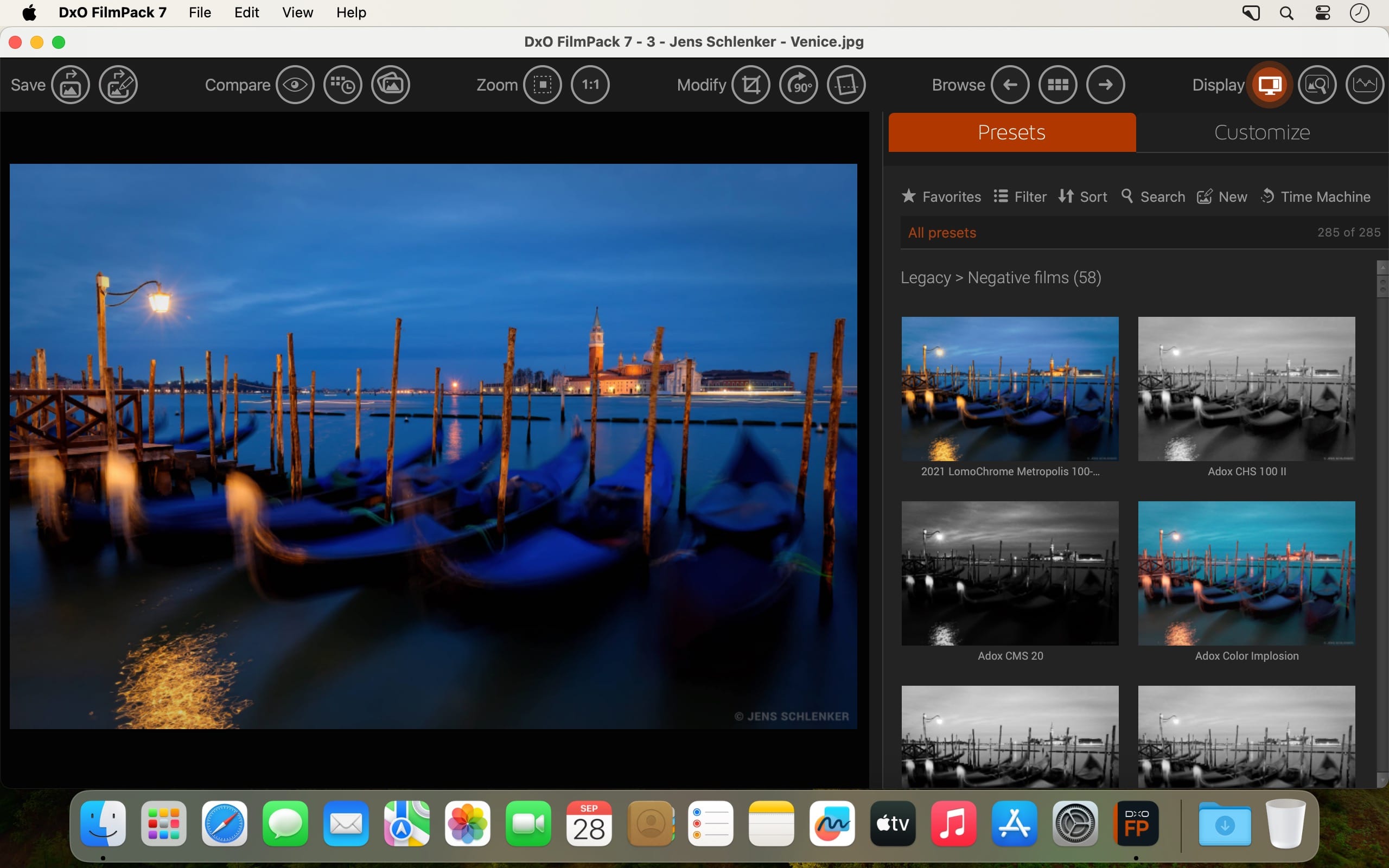
Integration with professional photography workflows is central to how DxO FilmPack is positioned and used. The Lightroom Classic plugin allows FilmPack rendering to be applied as a roundtrip edit from within Lightroom, with results returned as a separate copy that preserves the original catalog metadata and editing history. The standalone application provides direct RAW import capability with DxO's acclaimed optical corrections applied as the foundation before FilmPack rendering is added. This integration of technical correction with creative rendering in a single pipeline delivers a quality of final result that separate tools cannot match. For photographers who take their analog aesthetic seriously, DxO FilmPack Mac is the most historically faithful and technically rigorous film emulation available on macOS.
- Proprietary film rendering engine developed from physical film analysis by DxO Labs
- Extensive slide film and negative stock library including rare vintage emulsions
- Adjustable grain intensity and size parameters for custom analog texture
- Authentic color crossprocessing effects replicating darkroom chemical techniques
- Toning and split toning tools for refined monochrome and color styling
- Tone curve editing with per-channel control for precise color grading
- Histogram and overexposure warning overlays for technical exposure analysis
- Preset management with custom preset creation and organization tools
- Full 16-bit processing pipeline for maximum tonal depth and color accuracy
- Seamless Lightroom plugin integration for non-destructive workflow use
Compatible with macOS 11.0 and later on Intel and Apple Silicon Macs. DxO FilmPack is available as a standalone application or as part of the DxO Photo Suite bundle. Plugin support for Adobe Lightroom Classic 6+ and Photoshop CS6+ is included at no additional cost.